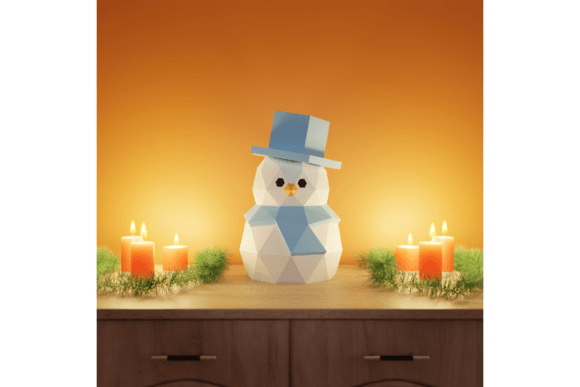
Strategic Design and Execution: The 3D Papercraft Snowman as a Dual-Purpose Asset
In the realm of physical prototyping, brand activation, and creative education, the choice of medium often dictates the success of the final output. While digital assets dominate modern workflows, tangible objects possess a unique psychological weight that screens cannot replicate. The 3D Papercraft Snowman represents more than a seasonal novelty; it is a case study in resource efficiency, modular design, and strategic planning. By approaching this project not merely as a craft but as a deliberate execution of design principles, creators and business owners can extract significant value regarding cost management, audience engagement, and operational flexibility.
This specific model, designed by Paperpoly, offers a compelling framework for decision-makers looking to understand how low-fidelity prototyping can yield high-impact results. The core innovation lies in its dual functionality: through the strategic application of color—specifically swapping white components for black—the same structural template transforms from a snowman into a penguin. This "two-in-one" capability is not just a clever trick; it is a lesson in adaptable asset creation. For marketers and educators, this demonstrates how a single investment in design and materials can serve multiple campaigns or educational modules without requiring entirely new supply chains.
Resource Allocation and Material Strategy
Effective project management begins with accurate resource forecasting. Before initiating any physical production, one must audit the required inputs against available inventory. For the 3D Papercraft Snowman, the bill of materials is precise and manageable, making it an ideal candidate for small-batch production or classroom settings. The project requires a total of 19 sheets of A4 or US letter paper, broken down as follows:
- 10 sheets in White: The primary structural component for the snowman configuration.
- 8 sheets in Blue: Used for accent details, providing contrast and depth to the model.
- 1 sheet in Orange: Essential for the nose, adding a focal point of color.
The strategic implication here is inventory control. Unlike complex manufacturing processes that require specialized tooling or bulk ordering, this project utilizes standard office resources. However, material quality directly influences the structural integrity and aesthetic finish of the final product. To achieve professional-grade results, the use of Encore Cardstock 80 lb cover (216 gsm) is recommended. This weight provides the necessary rigidity to hold the geometric folds while remaining pliable enough for intricate assembly. For those sourcing materials, selecting the right substrate is a critical decision point that separates a flimsy prototype from a durable display piece. You can explore suitable options at the 12×12 Cardstock Shop (paid link), ensuring your raw materials align with the precision demands of the design.
Operational Workflow and Precision Execution
The transition from digital file to physical object requires a disciplined workflow. The 3D Papercraft Snowman is delivered as a DIY project containing SVG cutting files and PDF instructions. This format supports both manual crafting and automated cutting machines, offering flexibility based on your operational scale. Whether you are a freelancer creating a single client gift or an educator preparing thirty units for a workshop, the process remains consistent:
- Download and Unzip: Secure the digital assets and organize your file directory.
- Print the Template: Ensure your printer settings are scaled to 100% to maintain dimensional accuracy.
- Cut Out Parts: Use precision shears or a digital cutter to separate components cleanly.
- Fold Along Lines: Adhere strictly to the mountain and valley fold indicators to ensure proper geometry.
- Glue Assembly: Follow the Visual Guide meticulously to bond tabs and faces securely.
This linear progression emphasizes the importance of following established protocols. In a business context, skipping steps or ignoring the visual guide often leads to structural failure or misalignment. Similarly, in strategic planning, bypassing foundational research or skipping pilot testing can result in flawed outcomes. The act of assembling the 3D Papercraft Snowman serves as a tactile reminder that attention to detail in the execution phase is what validates the initial design concept.
Dimensional Planning and Spatial Considerations
When integrating physical objects into a retail environment, office space, or educational setting, spatial awareness is paramount. Understanding the finished dimensions allows for effective space planning and logistics. When printed on standard A4 or US letter sheets, the completed model boasts the following specifications:
- Width: 24.8 cm (9.8 in)
- Height: 40 cm (15.7 in)
- Length: 26.9 cm (10.6 in)
These dimensions indicate a substantial presence, suitable for tabletop displays, shelf merchandising, or desk accessories. For event planners or store managers, knowing these metrics beforehand prevents overcrowding and ensures the display complements rather than clutters the environment. Furthermore, the height-to-width ratio suggests a stable, upright profile that draws the eye upward, making it an effective vertical element in horizontal arrangements.
Strategic Versatility: The Snowman-Penguin Paradigm
The most profound strategic advantage of this model is its modularity. The designer has engineered the geometry to be agnostic to color, allowing the user to dictate the narrative through pigment selection. By making selected parts black instead of white, the 3D Papercraft Snowman instantly becomes a penguin. This feature offers several practical applications for different stakeholders:
For Marketers and Brands: This duality allows for extended campaign lifecycles. A winter promotion can begin with the snowman theme and seamlessly transition to a penguin theme for late-season clearance events without purchasing new molds or redesigning the product. It maximizes the return on investment (ROI) for the initial design effort.
For Educators and Trainers: This serves as an excellent tool for teaching adaptability and lateral thinking. Students can analyze how changing a single variable (color) alters the entire perception of the object. It encourages experimentation within a fixed framework, a valuable skill in problem-solving and innovation.
For Content Creators: The transformation provides built-in content opportunities. Documenting the switch from snowman to penguin creates engaging before-and-after narratives for social media, driving engagement through visual storytelling.
Risk Mitigation and Intentional Usage
While the 3D Papercraft Snowman is a robust design, relying on it without clear intent can dilute its impact. A common pitfall in creative projects is the "shiny object syndrome," where tools are adopted for their novelty rather than their utility. Deploying this papercraft without a defined goal—such as brand reinforcement, customer gifting, or skill development—results in wasted resources and clutter.
To mitigate this risk, practitioners should define the objective prior to printing. Ask: What behavior am I trying to encourage? What message does this object convey? If the answer is unclear, the project may lack strategic direction. Additionally, consider the environmental context. Paper products, even heavy cardstock, have limitations regarding durability and weather resistance. Placing the model in high-traffic areas prone to moisture or rough handling without protective casing could lead to premature degradation. Thoughtful placement and maintenance protocols are essential for long-term viability.
Long-Term Value and Creative Decision Making
Ultimately, the value of the 3D Papercraft Snowman extends beyond the holiday season. It stands as a testament to the power of thoughtful design and efficient resource utilization. In a world increasingly dominated by disposable goods, creating something tangible, intricate, and reusable fosters a deeper connection with the audience. It signals a commitment to quality and creativity that resonates with consumers and stakeholders alike.
By treating this project as a strategic exercise rather than a mere pastime, professionals can hone their skills in planning, execution, and adaptation. Whether used to enhance customer experience, streamline operational prototypes, or educate the next generation of creators, the principles embedded in this papercraft model are universally applicable. The key lies in intentionality: choosing the right materials, following the process with discipline, and leveraging the inherent flexibility of the design to meet evolving goals. As you plan your next creative initiative, consider how a simple shift in perspective—much like turning a snowman into a penguin—can unlock new possibilities and drive better results.